



みんなで学ぶ
Learn together
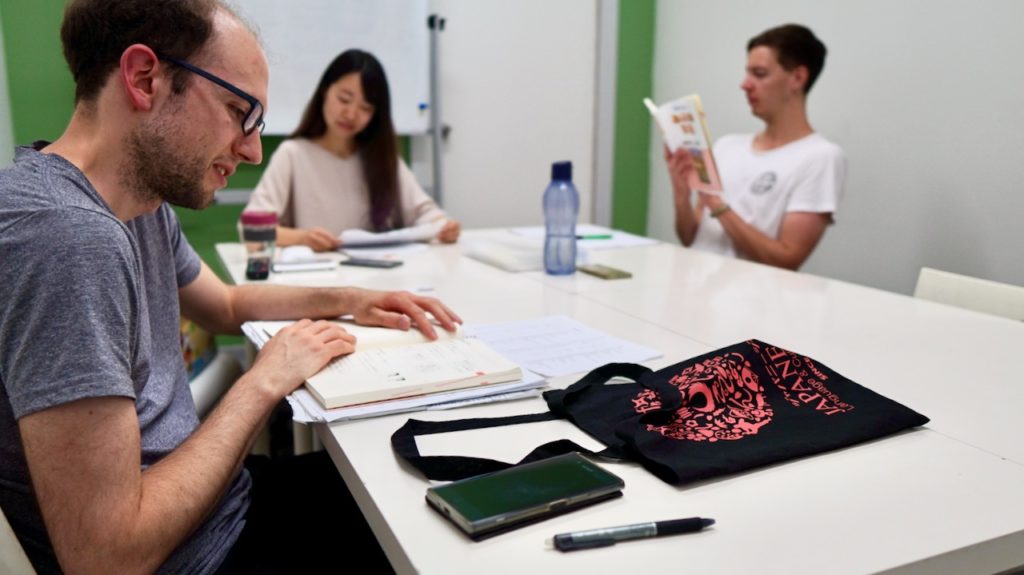
Our group lessons provide a small, friendly and engaging atmosphere to facilitate your learning. You will get to know your teacher and classmates well through activities and group practice. After a term ends, most groups will continue onto the next level at the same day and time, with similar group members. You’ll be able to learn not only from your teacher, but also from your classmates. The General course will suit most students needs, and we also offer JLPT course and Focus on Communication course for those who wish to focus on those specific areas.
Most effective method
We take a flipped teaching style – You watch the lecture videos before your class, then in the classroom you can focus on more practice and activities, which is easy to follow and speeds up your learning.
“These pre-lesson videos are a great initiative. An initiative that clearly has taken much time and trouble to prepare.”
※Only for General Group Course Beginner-1 to Intermediate- 5 level

A clear goal for each lesson
Why set a clear goal for each lesson? By defining the goal, you have a much clearer idea of what you can achieve by the end of the lesson. That means, you can practise with a clear mind, which leads to more effective learning, and encourages your learning

Enjoy learning and boost conversational skill
Learning should never be boring! Our teachers ensure that every lesson is filled with interesting takeaways and good laughs! Our small, interactive lessons ensure each student gets plenty of speaking practice.


Term Schedule for 2026
2026 Term Schedule
- Term 1: Jan 12th – Mar 7th
- Term 2: Mar 23rd – May 16th
- Term 3: Jun 1st – Jul 25th ★Enroll NOW★
- Term 4: Aug 2nd – Sep 26th
- Term 5: Oct 5th – Nov 28th
- Summer: Nov 30th –
Swipe to compare

Swipe to compare
General
ABOUT
Our most popular course with an all rounded curriculum covering everything including speaking, reading and writing.
KEY FEATURES
– Develop all rounded skills for a variety for situations
– Great for all levels including beginners who have never studied before
– Flipped teaching: Flipped lecture and practice time by watching a tutorial video which delivers grammatical explanations before lessons.
– The course covers JLPT contents
TEACHING METHOD
The lessons are conducted mainly in Japanese. The direct method focuses on full immersion in the classroom environment.
USEFUL LINKS
Syllabus
Level check
FEES
$484.00 (inc GST)
16 hours (2 hours / week for 8 weeks)
Level
PREREQUISITES
No requirement.
TEXTBOOK
Minna no Nihongo L1 – 4 (Romanised hard copy will be provided)
TOPICS
- Greeting
- Introduce yourself to your friends
- Meeting new people
- Daily Activities
- Numbers
- Asking Time
- Date expression
- Names of basic objects
- Conversation during shopping
- Conversation during a phone call
- Hiragana
GRAMMAR
- ~は〜です/じゃありません
- これ・それ・あれ は〜です
- ここ・そこ・あそこ は〜です
- いま 〜じ ですか?
- ~から 〜まで(VERB)
- 〜を(VERB)ます/ません/ました/ませんでした
Term
Class
PREREQUISITES
Can read and write hiragana.
TEXTBOOK
Minna no Nihongo L5 – 8
TOPICS
- Going and coming
- Transportation
- Daily Activities
- Everyday Conversation
- Inviting
- Giving and receiving
- KATAKANA
GRAMMAR
- Daily Verbs
- ~ませんか
- ~ましょう
- Particle summary
- あげます/もらいます
- ~は ADJECTIVE です
Term
Class
PREREQUISITES
Can read and write hiragana, katakana.
TEXTBOOK
Minna no Nihongo L9-13
TOPICS
- Expressing feeling
- Telling impression
- Like/dislike
- Asking & Telling reasons
- Excuse
- Visiting Japanese house
- Counters
- Family
- Describe places such as countries and your home
- Comparison/Superlative
- Expression of desire
- Describe purpose to go
- Restaurant conversations
- Simple Kanji Reading
GRAMMAR
- ~がすきです
- ~から、~です
- ~がいます/ あります
- ひとつ・ふたつ・・・・ひとり・ふた り・・・
- ~は Adjective でした
- ~のほうが~ より(ADJ)です
- いちばん(ADJ)です
- ~ がほしいです
- ~たいです。
Term
Class
PREREQUISITES
Can read and write hiragana, katakana, and some kanji.
TEXTBOOK
Minna no Nihongo L14-17
TOPICS
- Request and offering politely
- Action in progress
- Permission/expressing prohibition in public place
- Discuss Japanese custom
- Sightseeing
- More natural daily conversation
- Describing people/things
- Sick
- Hospital conversation
- Simple Kanji
GRAMMAR
– [て FORM]てください
– [て FORM]ています
– [て FORM]てもいいですか? [て FORM]ては いけません
– [て FORM]て、~て、~ます
– [ない FORM]ないで ください/なければ な りません
Term
Class
PREREQUISITES
Can read and write hiragana, katakana, and some kanji.
TEXTBOOK
Minna no Nihongo L18-21
TOPICS
- Expressing ability/hobby
- Talking experiences
- Telling your weekend activities
- Telling your dream
- Casual conversation between friends
- Expressing ideas/information/opinion
- Telling what you think
- passing the massage
- Kanji Reading & writing
GRAMMAR
– [じしょ (dictionary) FORM] ことができま す
-~前に、~
– [た FORM] ~たことがあ ります
– ~たり~たりします
– ~になりました
– VERB ふつう(Plain) form ~と思います
-~と言いました。
-~でしょう?
Term
Class
PREREQUISITES
Can read and write hiragana, katakana, and some kanji.
TEXTBOOK
Minna no Nihongo L22-25
TOPICS
- Noun modification(describing details)
- Talking about past experiences
- Direction
- Explain how to use tools
- Expressing gratitude
- Asking help politely
- Conditional
- Kanji Reading and writing
GRAMMAR
- ~と、~
- ~時、~
- ~てくれます/あげま す/もらいます
- ~てくれませんか? もし~ たら、〜いくら~ても~
Term
Class
PREREQUISITES
Can read and write hiragana, katakana, and some kanji.
TEXTBOOK
Minna no Nihongo L26-30
TOPICS
- Key to natural speaking expressions
- abilities
- Requests and advices politely
- Job interview conversations
- Polite refusal
- Giving more than 2 reasons
- Trouble situations
- Describe object naturally
- Planning and preparing
- Kanji
GRAMMAR
- ~んです。 可能(Potential)
- ~ながら、 ~
- ~し、~し・・・
- ~てしまいます
- 自動詞 (Verb intransitive)/他動詞(Verb transitive)
- ~てあります/~ておきます
Term
Class
PREREQUISITES
Can read and write hiragana, katakana, and some kanji.
TEXTBOOK
Minna no Nihongo L31-35
TOPICS
- Asking to going out to friends
- Planning and scheduling
- Giving advices and helps, Hospital
- Emergency
- Reading Japanese signs and understanding
- Travel
- Formal Telephone Conversation
- Giving instruction
- Guiding people
- Conditional
- Recommendation
- Kanji
GRAMMAR
- 意向(Volitional)
- ~つもりです
- ~予定 です
- ~ほうがいい
- ~かもしれません
- 命 令/禁止(imperative/prohibitive)形 行け/行くな
- ~とおりに~
- ~ないで~
- 条件 (Conditional)形 ~ば~
Term
Class
PREREQUISITES
Can read and write hiragana, katakana, and some kanji.
TEXTBOOK
Minna no Nihongo L36-40
TOPICS
- AIM, Indirect request
- Discussing change of situations
- Troubles and cheering up
- Express what you are like and what you think more naturally
- Formal Excuse
- Keeping a long chat in social life
- Your dream
- Cause and reasonsCauses of accidents
- Shopping conversations
- Kanji
GRAMMAR
- ~ように、~
- 受身(passive)形 ~られま す
- ~の(Nominalising verbs)は/が/を ~
- (Cause)て/で、~
- ~ので~
- ~かどう か、~
- ~てみます。
Term
Class
PREREQUISITES
Can read and write hiragana, katakana, and some kanji.
TEXTBOOK
Minna no Nihongo L41-45
TOPICS
- Meeting at office & school
- Understanding Japanese Hierarchy and Choosing right phrases
- Japanese Technology
- More detailed impression & expressing natural feeling
- Inquiries to public institution
- Making complaints
- Kanji
GRAMMAR
- ~をいただ きます
- ~をさし あげます
- ~をくだ さいます
- ~やります
- ~のために~
- ~そう です
- ~て来ます
- ~すぎます
- ~やすい/に くいです
- ~のばあいは~
- ~のに~
Term
Class
PREREQUISITES
Can read and write hiragana, katakana, and some kanji.
TEXTBOOK
Minna no Nihongo L46-50
TOPICS
- Asking delivery, Emotional expression
- Telling/listening to news, Expression through face senses
- Kids’ education
- Education in Japan
- Business conversations
- Talking gossip
- Visiting Japanese house
- Introducing yourself in business situations
- Understanding Japanese Hierarchy and conversation in the scene
- Writing formal letter
- Kanji
GRAMMAR
- ~ところです
- ~ばかりです
- ~はずです
- ~ そうです
- ~ようです
- 使役(Causative)形 (~させます)
- ~させていただけませんか
- 尊 敬(respectful)語 ~(ら)れます
- お~にな ります
- 謙譲(humble)語 お~します
Term
Class
PREREQUISITES
Can read and write hiragana, katakana, and some kanji.
TEXTBOOK
Chukyu e ikou
Pre-A1: L1-L4
Pre-A2: L5-7
Pre-A3: L8-10
AIM
・To be able to read and understand written materials with specific contents concerning everyday topics and talk about it.
・To be able to grasp summary information such as newspaper headlines and discuss it.
・To able to listen, speak and comprehend coherent conversations in everyday situations, spoken at near-natural speed, and is generally able to follow their contents and talk as well as grasp the relationships among the people involved.
Term
Class
PREREQUISITES
A thorough understanding of everyday grammar and a decent base of common Kanji.
TEXTBOOK
Quartet 1 (JLPT N4-3 level) or Chukyu o manabou
AIM
・To be able to read and understand written materials with specific contents concerning everyday topics and talk about it.
・To be able to grasp summary information such as newspaper headlines and discuss it.
・To able to listen, speak and comprehend coherent conversations in everyday situations, spoken at near-natural speed, and is generally able to follow their contents and talk as well as grasp the relationships among the people involved.
Term
Class
PREREQUISITES
Ability to understand and use polite expressions and know some less common Kanji.
TEXTBOOK
Quartet 2 or Tobira (JLPT N3-2 level)
AIM
・To able to read materials written clearly on a variety of topics, such as articles and commentaries in newspapers and magazines as well as simple critiques, and comprehend their contents, and discuss it.
・To able to read written materials on general topics and follow their narratives as well as understand the intent of the writers.
・To able to comprehend orally presented materials such as coherent conversations and news reports, spoken at nearly natural speed in everyday situations as well as in a variety of settings, and is able to follow their ideas and comprehend their contents. Also to able to understand the relationships among the people involved and the essential points of the presented materials and speak correctly.
Term
Class
Term
Class
PREREQUISITES
Ability to understand and use polite expressions and know some less common Kanji.
TEXTBOOK
人と社会をつなぐ日本語 上級 (JLPT N2-N1 level)
AIM
・To able to read writings with logical complexity and/or abstract writings on a variety of topics, such as newspaper editorials and critiques, and comprehend both their structures and contents and discuss it.
・To able to read written materials with profound contents on various topics and follow their narratives as well as understand the intent of the writers comprehensively and discuss it.
・To able to comprehend orally presented materials such as coherent conversations, news reports, and lectures, spoken at natural speed in a broad variety of settings, and is able to follow their ideas and comprehend their contents comprehensively. Also to able to understand the details of the presented materials such as the relationships among the people involved, the logical structures, and the essential points.
Term
Class
Focus on Communication / Travel Conversation
ABOUT
You can focus on more communication (Speaking & Listening) in this course to learn both language and culture, features real-life communication in lessons, and allows students to experience the lifestyle and culture behind this communication.
KEY FEATURES
– Focus on speaking, listening and communicating.
– Learn both language and culture
– Suitable if you want to learn simple conversation in short term
– Travel conversations
TEACHING METHOD
The lessons are conducted in both English and Japanese so you can fully understand what is taught in the classes. This course does not include flipped-learning videos, which are used only in our General Group Courses (Beginner-1 to Intermediate-5).
USEFUL LINKS
Syllabus (Coming soon)
Level check
FEES
$253.00 (inc GST) for 8 hours course (Travel / Advanced)
$484.00 (inc GST) for 16 hours course
Level
PREREQUISITES
No requirement.
TEXTBOOK
No requirement.
For those who are being a bit nervous to travel in Japan not knowing any words / phrases.
This course will complete in 8 hours and help you boosting self confidence in communicating and that will make your stay more memorable!
* You won’t learn Japanese character in this course
If you would like to learn Japanese for a long term, then please join FOC Elementary A or General Beginner-1 course.
TOPICS
- Greeting & Simple Self-Introduction
- Ordering food
- Shopping conversation
- Conversation at a hotel, airport, station
※This class completes in 1 term, there is no next level.
※This course does not include flipped-learning videos, which are used only in our General Group Courses (Beginner-1 to Intermediate-5).
Term
Class
PREREQUISITES
No requirement.
TEXTBOOK
Marugoto Nyumon
TOPICS
- Exchange greeting
- Write your name and country
- Self-introduction
- Talk about your family
- Say what you like/dislike
- Order food and drinks
- Say where you live
- Visit/welcome friends
GRAMMAR
- ~は〜です
- 〜ができます
- 〜にすんでいます
- 〜がすきです
- 〜を 〜ます
- 〜はAdjです
- 〜があります・います
Term
Class
PREREQUISITES
For people who have some basic Japanese (knowing simple verbs and adjectives sentences)
TEXTBOOK
Marugoto Nyumon
TOPICS
- Talk about your daily routine and your schedule for this week
- Talk about your hobbies
- Recognise information on posters and calendars for events
- Say how to get to a particular destination
- Use a map
- Do some shopping
- Talk about your day off and travel
GRAMMAR
- Time
- 〜から〜までです
- 〜がいいです
- 〜がすきです
- 〜ができます
- 〜があります
- 〜にいきます
- 〜ませんか
- 〜ましょう
- 〜から
- Adj+Noun
- Position
- 〜があります・います
- ほしいです
- あげます・もらいます
Term
Class
PREREQUISITES
For people who have some basic Japanese (knowing simple verbs and adjectives sentences)
TEXTBOOK
Marugoto Nyumon
TOPICS
- Talk about your daily routine and your schedule for this week
- Talk about your hobbies
- Recognise information on posters and calendars for events
- Say how to get to a particular destination
- Use a map
- Do some shopping
- Talk about your day off and travel
GRAMMAR
- Time
- 〜から〜までです
- 〜がいいです
- 〜がすきです
- 〜ができます
- 〜があります
- 〜にいきます
- 〜ませんか
- 〜ましょう
- 〜から
- Adj+Noun
- Position
- 〜があります・います
- ほしいです
- あげます・もらいます
Term
Class
PREREQUISITES
FOC Course Elementary C
TEXTBOOK
Marugoto Nyumon
Contents
Summary and more exercises of Elementary A to C
Term
Class
PREREQUISITES
For people who have learnt about 50 hours Japanese (knowing some elementary B contents, Recognising Hiragana)
TEXTBOOK
Marugoto Shokyu 1
TOPICS
- Talk about your family and friends
- Give comments about self-introductions
- Greet people and talk about weather
- Talk over the phone
- Tell your recommendation
- Tell how to get to a place
- Set a meeting time and place
- Invite a friend to visit
GRAMMAR
- ~ています
- ~ること
- ~とき
- ~になります
- ~のがすきです
- ~でした
- Reasonから~
- Adjくて・でAdj
- ~てください
- ~て、~
- ~てもいいですか
- ~にいきます
- ~まえ・あとに~
- ~のがAdj
- ~てくださいませんか
- ~てみます
- ~ましょうか
Term
Class
PREREQUISITES
For people who have learnt about 75 hours Japanese (knowing some Beginner A contents)
TEXTBOOK
Marugoto Shokyu 1
TOPICS
- Talk about your language study
- Offer help
- Plan an event
- Offer a dish
- Respond to an offer
- Greet a visitor
- Introduce your colleagues
- Listen to some easy exercises
- Talk about your health
- Complement a friend
- Discuss for a friend’s celebrations
GRAMMAR
- ~ていきます
- AとBとどちらが~
- ~そうです
- ~たことがあります
- ~すぎます
- ~が、~
- ~てもいいですか
- ~つまえに~
- ~るといいです
- ~ないでください
- ~たり~たりしています
- Noun modification
- Plain form
- あげます・もらいます
- ~とおもいます
- ~といっていました
Term
Class
PREREQUISITES
For people who have learnt about 100 hours Japanese (knowing some Beginner B contents)
TEXTBOOK
Marugoto Shokyu 2
TOPICS
- Self-introduction with a dew details
- give your first impression
- Talk about your recommended dish
- Order a meal
- Ask/tell about what a sightseeing spot is like
- Comment on a tour
- Ask a question at a staff meeting
- Make a simple speech
GRAMMAR
- ~といういみ
- Noun modification
- ~ています
- ~そうです
- ~ので~
- ~のは~です
- ~なら~
- ~てはいけません
- ~てから~
- ~て・ないで~
- ~ると~
- ~たほうがいいです
- ~とき~
- Potential verb
- ~し、~し、~です
- Conditionalたら~
- ~か、しっていますか
Term
Class
PREREQUISITES
For people who have learnt about 125 hours Japanese (knowing some Upper Beginner A contents)
TEXTBOOK
Marugoto Shokyu 2
TOPICS
- Tell about holidays
- Talk about seasonal event
- Talk about online shopping
- Compare two products
- Talk about a famous place
- Talk about rules
- Talk about an eco-friendly activity
- Talk about recycling
- Say what you know about a famous person and why
- Talk about a memory of your childhood days
GRAMMAR
- Potential verb
- ~ていました
- ~ように~
- ~なくなりました
- ~てしまいました
- ~ないで~
- ~にくい・やすいです
- ~のほうがAdjです
- Passive verb
- ~ために~
- ~てあります
- ~ようにしています
- ~のにいいです
- Conditionalたら
- ~そうです
- ~てから
- ~かもしれません
- ~ようになりました
- ~なくなりました
Term
Class
This level is around Itermediate-5 class in our General course. (N4 level)
Term
Class
This level is around Advanced-B class in our General course. (N3-N2 level)
Term
Class
PREREQUISITES
JLPT N2-N1 level
TOPICS
- Discuss a variety of topics by using news papers articles, current dramas and modern issues in Japan, and build a variety of newest vocabulary and expressions in current affair.Also look at formal/informal model conversation, modern Japanese and the way native speaker speak.
Examples
- 日本のニュース
- オーストラリアのニュース
※8 hours course($253)
Term
Class
JLPT
ABOUT
The essential course for those planning to take the JLPT. Recommended for students who have completed the general class or want to review before the exam.
KEY FEATURES
– Useful exam tips for the Japanese Language Proficiency Test
– High success rate – more than 80% of our students pass every year.
– Japaneasy teachers are JLPT exam proctors/assistants
– Good to have certification for working in Japan
FEES
$484.00 (inc GST)
16 hours (2 hours / week for 8 weeks)
Level
PREREQUISITES
General Course Pre-Intermediate
KANJI
100
VOCABULARY
800
STUDY HOURS
150
TEST SECTIONS
Vocabulary (25 min)
Grammar / Reading (50 min)
Listening (30 min)
PASS MARK
80 / 180
Term
Class
PREREQUISITES
General Course Intermediate 5
KANJI
300
VOCABULARY
1500
STUDY HOURS
300
TEST SECTIONS
Vocabulary (30 min)
Grammar / Reading (60 min)
Listening (35 min)
PASS MARK
90 / 180
Term
Class
PREREQUISITES
General Course Advanced A
KANJI
650
VOCABULARY
5,750
STUDY HOURS
450
TEST SECTIONS
Vocabulary (30 min)
Grammar / Reading (70 min)
Listening(40 min)
PASS MARK
95 / 180
Term
Class
PREREQUISITES
General Course Advanced B
KANJI
1,000
VOCABULARY
6,000
STUDY HOURS
600
TEST SECTIONS
Vocabulary / Grammar / Reading (105 min)
Listening (50 min)
PASS MARK
90 / 180
Term
Class
PREREQUISITES
General Course Advanced C
KANJI
2,000
VOCABULARY
10,000
STUDY HOURS
900
TEST SECTIONS
Vocabulary / Grammar / Reading (110 min)
Listening (60 min)
PASS MARK
100 / 180